Number Fair › How to play
Balance Booth
Every shape weighs something, but nobody knows how much. Work out each weight so every scale balances. Kangaroo the juggler brings you a gentle first step into algebra.
The goal
Work out the weight of each mystery shape, then use that to balance the scale.
The rules
- Equal shapes weigh the same. Every star weighs one fixed amount, and so on for each other shape.
- A balanced scale means both sides are equal. That is what = really means: “the same as”.
- Take the same off both sides and the scale stays balanced. This is the key trick.
- No algebra symbols at first. Letters such as x and y arrive in the middle chapters, once the idea is solid.
How to play it
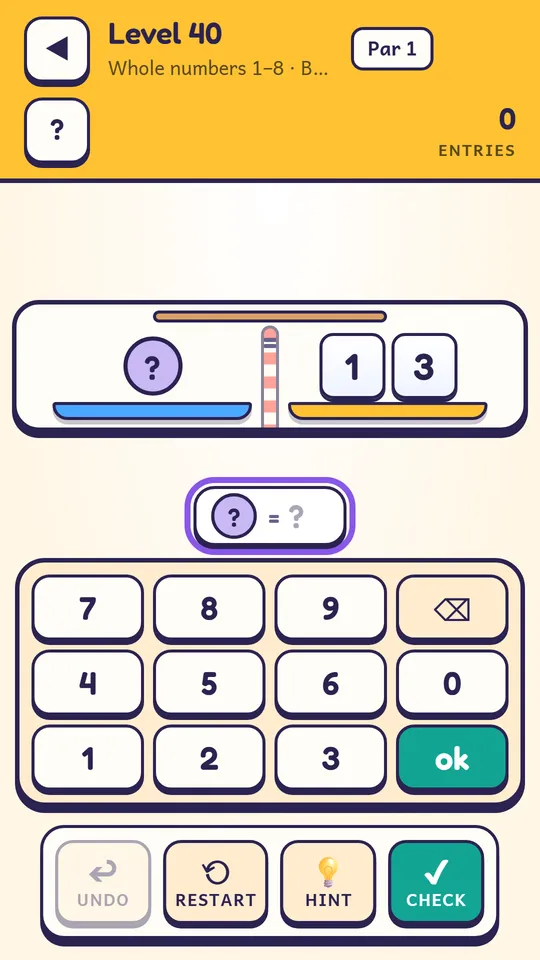
- Tap a shape or a number weight, then tap a pan, or drag it across.
- A wrong guess makes the scale tip the wrong way, so you can see what is going on.
- Hint has three steps: look at the pan with only numbers, then the method, then it does one step. Undo and Restart are free.
Worked examples
One mystery shape
The left pan has a star and a 3. The right pan has an 8. The scale balances.
Working it outTake 3 off both sides. The left has just the star and the right has 8 − 3 = 5. So the star weighs 5.
Two scales
Scale 1: star + star = 10. Scale 2: star + moon = 7.
Working it outScale 1 gives star = 5. Put that into scale 2: 5 + moon = 7, so the moon weighs 2.
No pencil needed. Every puzzle in the game is built so you can reason to the one right answer.
What is new as you go
Each new idea arrives with a short tip, so the game teaches its own tricks in order. The same skill shows up first with objects you can move, then as a diagram, then as plain numbers.
- Chapter 1
Balance with numbers
3 + 4 = ? + 2. Both pans must come to the same.
- Chapter 3
One unknown shape
“Star + 3 = 8”.
- Chapter 5
Two scales, two shapes
Use one scale to find a shape, then put it into the other.
- Chapter 6
Letters
Shapes become x and y, and patterns and missing terms appear.
- Chapter 8
Same to both sides
Add or remove the same on both pans. Heavier and lighter (inequalities) appear.
- Chapter 9
Number machines
Function in, function out, and substitution.
How the levels grow
Each game has 10 chapters of 100 levels, and each chapter is a stop on the tour, with its own backdrop. Chapters follow school years 1 to 6, and the last chapter is Expert.
- Chapter 1
Morning Gate
Balance with numbers only
- Chapter 2
Carousel Row
Missing number
- Chapter 3
Bunting Lane
One unknown shape
- Chapter 4
Midway Lights
One shape on both sides
- Chapter 5
Candy Corner
Two scales, two unknowns
- Chapter 6
Big Top
Letters x and y, patterns
- Chapter 7
Sunset Parade
Three unknowns, multiplication
- Chapter 8
Lantern Hill
Same to both sides, heavier and lighter
- Chapter 9
Grand Fireworks
Number machines and formulae
- Chapter 10
Fireworks Night
Expert: operations on both pans, negative weights
Three challenges
Fluency Run
A set of scales on one skill, with an optional relaxed timer.
Clean Sheet
No hints and no Check as I go.
Big Boss
Three scales and three unknowns.
Win 3, 10 and 25 of a kind to earn Bronze, Silver and Gold rosettes for the Prize Book. Rosettes are just for fun and never lock anything away.
Helping without spoiling it
- Ask: “Which pan has only numbers on it?” That is usually where to start.
- “What could you take off both sides?” is the most useful question in the game.
- Kids who find algebra scary tend to find this friendly, because there are no symbols to be afraid of.
Hints are always there, undo is unlimited and nothing is ever lost, so it is fine to let them struggle for a while first. There are no timers to beat unless a child asks for one, and stars measure accuracy, never speed.