Number Fair › How to play
Ring Toss
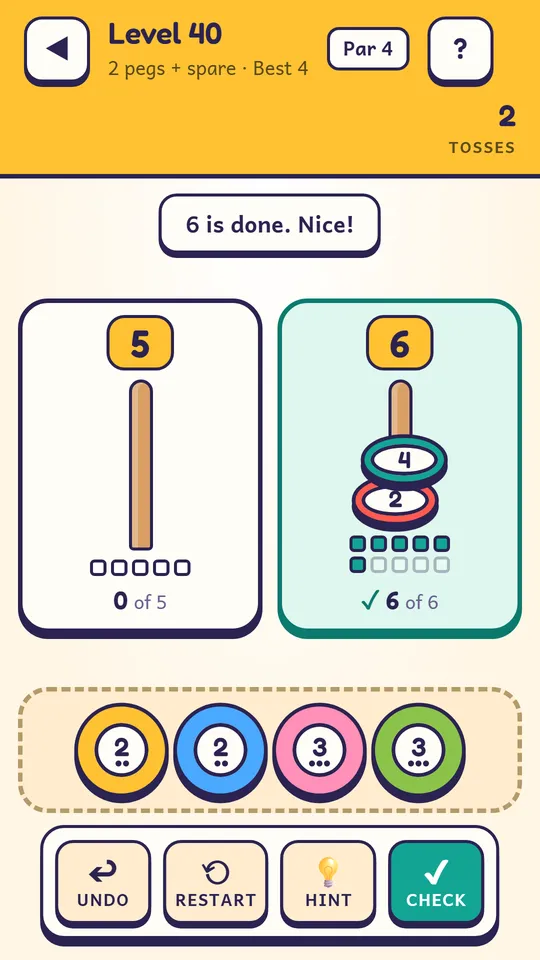
Toss the rings onto the pegs so every peg adds up to its number. Hippo, the ring-toss champion, needs a hand with adding and taking away.
The goal
Land every ring on a peg so each peg's total matches its target number. Every ring is used exactly once.
The rules
- Each peg has a target. The rings on it must add up to exactly that number.
- Use every ring once. There is exactly one way to place them all, and you can always find it by reasoning.
- Take-away rings (later chapters) knock a value off the peg instead of adding to it.
- Early levels show helpers such as ten-frames and number lines, so you can see the total building up. They fade out as you grow in confidence.
How to play it
- Tap a ring, then tap a peg, or drag it across. Tap a ring on a peg to take it off again.
- The peg shows its running total, so you can see how far you still have to go.
- Hint has three steps: something to look at, then a method, then it shows one step. Undo and Restart are free.
Worked examples
Starting with the peg that has the fewest options
Peg A needs 10 and peg B needs 3. You hold rings 6, 4 and 3.
Working it outOnly the 3 ring fits peg B on its own. That leaves 6 + 4 = 10 for peg A, and every ring is used.
Taking away
A peg shows 15 and the target is 9. The take-away rings are 2, 4 and 6.
Working it outYou need to remove 15 − 9 = 6 in total. A single 6 ring would do it, or 2 + 4. Which one is right depends on what the other pegs need, so check them too.
No pencil needed. Every puzzle in the game is built so you can reason to the one right answer.
What is new as you go
Each new idea arrives with a short tip, so the game teaches its own tricks in order. The same skill shows up first with objects you can move, then as a diagram, then as plain numbers.
- Chapter 1
Count on
Start from the bigger number and count up. Ten-frames show the bonds to 5 and 10.
- Chapter 2
Make 10
Make a ten first: 8 + 5 is 8 + 2 + 3.
- Chapter 3
Tens and ones
Add the tens, then the ones.
- Chapter 4
Carrying and borrowing
Notice when the ones pass 10, and when you must borrow from the tens.
- Chapter 7
Mental strategies
Compensate (add 9 by adding 10 and taking 1), split numbers, count up to find a difference.
- Chapter 9
Negative numbers
Use the number line to go below zero.
How the levels grow
Each game has 10 chapters of 100 levels, and each chapter is a stop on the tour, with its own backdrop. Chapters follow school years 1 to 6, and the last chapter is Expert.
- Chapter 1
Morning Gate
Counting on and bonds to 5 and 10
- Chapter 2
Carousel Row
Add and subtract within 20: make 10, doubles
- Chapter 3
Bunting Lane
Within 100 without carrying
- Chapter 4
Midway Lights
Within 100 with carrying and borrowing
- Chapter 5
Candy Corner
Three-digit numbers
- Chapter 6
Big Top
Four-digit numbers and estimating
- Chapter 7
Sunset Parade
Mental strategies, multi-step
- Chapter 8
Lantern Hill
Big numbers and decimals to hundredths
- Chapter 9
Grand Fireworks
Negative numbers, missing-number chains
- Chapter 10
Fireworks Night
Expert: many pegs, mixed adding and removing
Three challenges
Fluency Run
A set of pegs on one skill, with an optional relaxed timer that never fails you.
Clean Sheet
Check as I go is off and hints are not allowed.
Big Boss
A wall of twelve pegs.
Win 3, 10 and 25 of a kind to earn Bronze, Silver and Gold rosettes for the Prize Book. Rosettes are just for fun and never lock anything away.
Helping without spoiling it
- Ask: “Which peg has the fewest ways to be made?” and start there.
- If a sum is tricky, ask them to say it another way: “what do I add to 8 to get 15?”
- A wrong ring just wobbles and shows what the total would have been. Let them try it.
Hints are always there, undo is unlimited and nothing is ever lost, so it is fine to let them struggle for a while first. There are no timers to beat unless a child asks for one, and stars measure accuracy, never speed.