Puzzle Deep › How to play
Tide Code
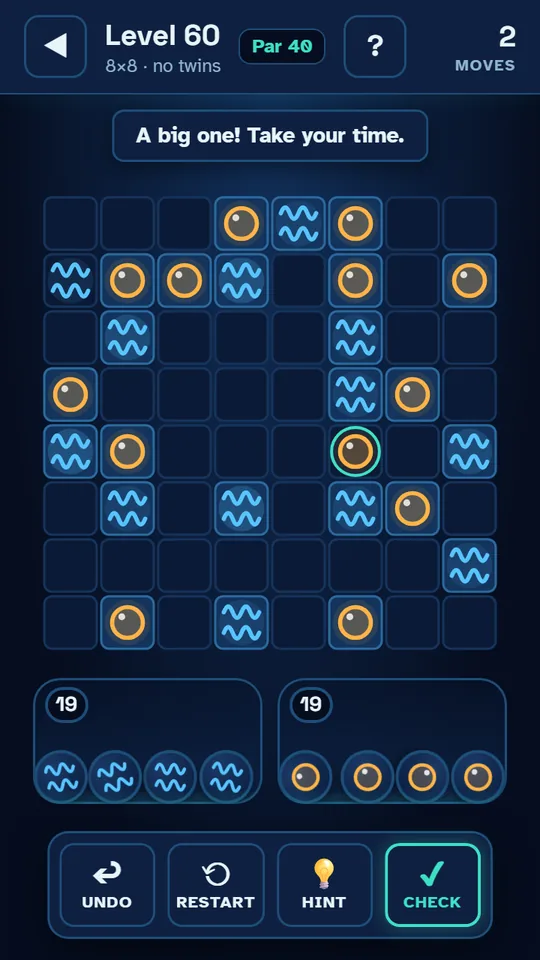
A grid of waves and bubbles with a few already placed. Fill the rest using three simple rules. No guessing: every grid has exactly one answer, and you can always reach it by reasoning.
The goal
Every empty cell holds either a wave or a bubble. Fill the whole grid so that all the rules hold at once.
The rules
- Never three alike. No row or column may have three waves or three bubbles in a row.
- Equal numbers. Every row and every column holds the same number of waves as bubbles. In a 6×6 grid that is three of each.
- No twins (from level 31). No two rows are identical, and no two columns are identical.
- Locked cells. The pieces that are already there at the start cannot be changed. From level 61 some have a ring: these are sonar anchors, locked like the rest.
How to play it
- Drag a wave or a bubble from the tray under the board onto a cell. The badge on each bucket shows how many you have left.
- Drag a piece you have placed to move it. Drop it on another piece to swap them.
- Drag a piece off the board and it falls back into its bucket, or just tap it to clear it.
- Hint names the technique to look for before it points to a cell. Undo and Restart are always free. Check shows any wrong piece (you can turn this off).
Worked examples
Rule 1 in action: two alike means the third is different
Rule 2 in action: counting
Putting it together
Real levels chain these ideas. Find the cell that is forced, place it, and the next forced cell appears. If you are ever stuck, look at the line with the fewest gaps: it has the fewest ways to finish. Imagine every way it could end. A cell that is the same in all of them is certain.
Techniques you will learn
Hints name the technique to look for before they point at a cell, so playing the game teaches these in order.
- From the start
Triples and Sandwich
Two alike means the next one differs. A gap between two alike must be the other piece.
- From the start
Count complete
When a line already has its full share of one piece, fill the rest with the other.
- Level 11
Nearly done
A line with only a few gaps has only a few ways to finish. Try them all in your head.
- Level 31
No twins
No two rows or columns can match. Compare an almost finished line with a finished one.
- Level 91
Every ending
For a tricky line, imagine every legal ending. A cell that is the same in all of them is forced.
How the levels grow
Levels 1 to 8 use a 4×4 grid, then 6×6, 8×8, 10×10, 12×12 and finally 14×14. From level 31 the no-twins rule joins in. Levels 121 to 150 are Expert dives, the hardest grids of all. The last 30 levels are Expert dives. Every level shows a par, and you collect Bronze, Silver and Gold seals in your Dive Log.
Three challenges
Quick Ping
Fill a medium grid before the clock runs out.
Clean Sweep
No hints on screen: one wrong piece ends the dive.
Deep Grid
The biggest grids, with no anchors to help.
Helping without spoiling it
- Ask: “Which row or column has the fewest empty cells?” That is almost always where to start.
- If your child places something and the Check button flags it, ask them to say which rule it breaks. Naming the rule is the skill.
- Counting out loud (“that is three waves already”) fixes most mistakes.
There is always a hint, and in the normal game a mistake never ends a level, so it is fine to let them struggle for a while first.