Puzzle Summit › How to play
Code Climber
Program a clockwork goat to reach the summit flag. Build a program from tiles for steps, turns and jumps, then press Run and watch it go. Later you will use loops, your own function and if-tests.
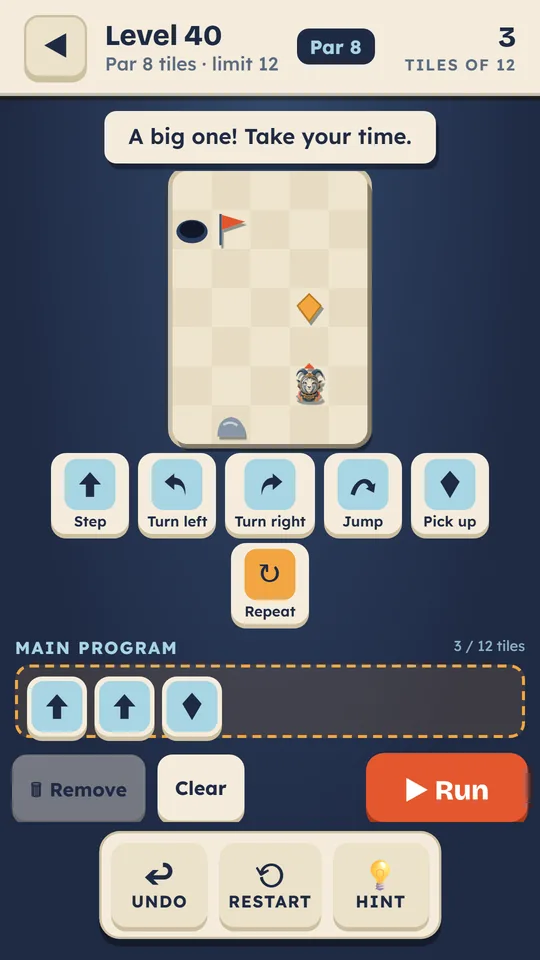
The goal
Write a program that takes the goat to the flag. For more stars, make the program shorter.
The rules
- The goat does exactly what the tiles say, one after another, from the top of the program.
- Tiles: Step, Turn left, Turn right, Jump, Pick up, Repeat, Function and If. New tiles appear as you climb.
- Stars: one for reaching the flag, two for staying within the tile limit, three for matching par (the shortest program the game knows).
- Tiles inside a Repeat or If count too, so shorter programs use loops and functions well.
How to play it
- Tap a tile from the row to add it to your program. Tap a tile in the program to select it.
- Repeat has a number you can change with the − and + buttons.
- Press Run. The goat follows the program and the game shows which tile it is on. If it goes wrong, it says why. Hint offers help with the program, and Undo and Restart are free.
Worked examples
Example 1: steps and turns
Example 2: repeat does the counting
Example 3: jump over a pit
The other tiles
- Pick up (from level 14) collects a gem on the tile the goat stands on. All gems must be collected before the flag counts.
- Function f (from level 91) is a mini-program you build once. Each time you use the f tile it runs the whole thing, so a pattern that repeats can be written once.
- If (from level 121) runs the tiles inside it only when its test is true, for example when a wall is ahead or a gem is here.
Press Run to watch the goat follow your program, one tile at a time. If it fails, the game says why (a wall, a pit, a missed gem) and shows which tile did it.
What is new as you climb
Each new idea arrives with a one-line tip, so the games teach their own tricks in order.
- From the start
Step and turn
The basics: Step moves one tile, Turn left and Turn right swap direction.
- Level 8
Jump
It hops two tiles ahead, over a pit or a low rock.
- Level 14
Pick up
Gems must be collected before the flag counts.
- Level 31
Repeat
Put tiles inside a Repeat to loop them. The number says how many times.
- Level 91
Function
Build a mini-program once, then use the f tile to run it whenever you like.
- Level 121
If
The tiles inside only run when the test is true.
How the levels grow
The five zones are Gear Foothills, Loop Terraces, Jump Ledges, Function Ridge and the Final Ascent. Each introduces the next idea. The puzzles are made by building a solution first and then the world around it, and a search looks for shorter programs, which is what par is. The last 30 levels are Expert summits. Every level shows a par and keeps your personal best, and you collect Bronze, Silver and Gold stamps in your Expedition Journal.
Three challenges
Shortest Program
Solve it with par tiles or fewer.
One Run
You only get one test run. Check the program in your head!
Function Peak
You must use the function tile.
Helping without spoiling it
- Ask: “What will the goat do after that tile?” Predicting a program before running it is the core skill of programming.
- When a program fails, ask which tile went wrong. The game highlights it, and the failure is information, not a mistake.
- Repeat, functions and if-tests are the building blocks of real programming languages, so this is a gentle first look at them.
Hints are always there, undo is unlimited and nothing is ever lost, so it is fine to let them struggle for a while first.