Puzzle Deep › How to play
Cable Loop
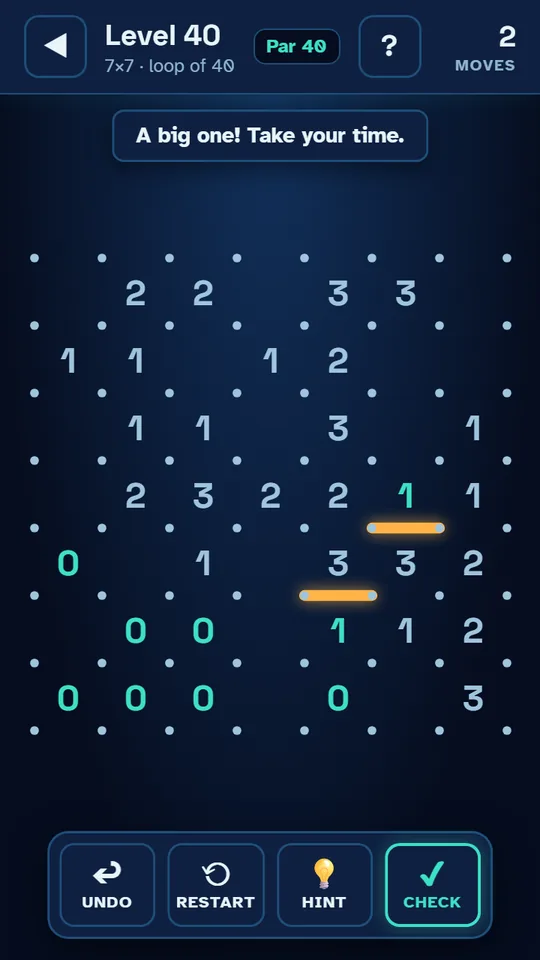
Join the dots into one single loop of cable. The numbers in the squares tell you how many of that square’s four sides carry cable. There is only one loop that satisfies every number.
The goal
Draw a single closed loop along the lines between the dots so that every number is satisfied.
The rules
- One loop. The cable never branches, never crosses itself and never stops. Every dot it touches has exactly two cables.
- Numbers count sides. A 2 means exactly two of the square’s four sides carry cable. A 0 means none.
- Empty squares are free. A square with no number can have any amount.
- It must be a single loop, not two separate loops.
How to play it
- Tap the line between two dots to lay cable. Tap it again to take it away. That is the only action.
- Fill in what you are sure of first. The numbers turn teal when they are satisfied.
- Hint names the technique before it shows you a line. Undo, Restart and Check work as in every Puzzle Deep game.
Worked examples
Two numbers that tell you a lot
A whole puzzle
Here is a small board with just five numbers. Try it before you look at the answer: there is only one loop that works.
Bigger boards use the same ideas more often. Look at one number and every way its cable could go; an edge that is the same in all of them is certain.
Techniques you will learn
Hints name the technique to look for before they point at a cell, so playing the game teaches these in order.
- From the start
Counting
A 0 means no cable. A number equal to its open edges means all of them carry cable.
- From the start
Dead ends
A dot with two cables is finished. A dot with one cable and one open edge must continue along it.
- Level 11
One number, every way
Try every way a numbered square could be satisfied. An edge that appears in all of them is certain.
- Level 31
Neighbouring numbers
Look at two numbers side by side, especially a 3 next to a 3, or a 3 next to a 0.
- Level 61
No early loop
A cable that would close a small loop while other numbers still need cable cannot be right.
- Level 91
What if
Pick an open edge beside a loose end and imagine cable there. If that breaks a rule, the edge is empty.
How the levels grow
Boards grow from 4×4 at the start through 5, 6, 7, 8 and 9 to 10×10 near the end, and the numbers get sparser as you go. The last 30 levels are Expert loops with the fewest clues. The last 30 levels are Expert dives. Every level shows a par, and you collect Bronze, Silver and Gold seals in your Dive Log.
Three challenges
Short Circuit
Close the loop before the power fails.
Clean Wire
One wrong segment ends the job, and nothing marks it for you.
Grand Loop
The biggest board with the fewest numbers.
Helping without spoiling it
- Ask: “Which number has the fewest choices left?” Starting at 0s, 3s and corners is the usual way in.
- A good habit is to follow a loose end: where can this cable go next without breaking a number?
- This is the same puzzle as Slitherlink, which is popular with older kids and adults. It is a good one to try alongside them.
There is always a hint, and in the normal game a mistake never ends a level, so it is fine to let them struggle for a while first.