Puzzle Deep › How to play
Reef Sweep
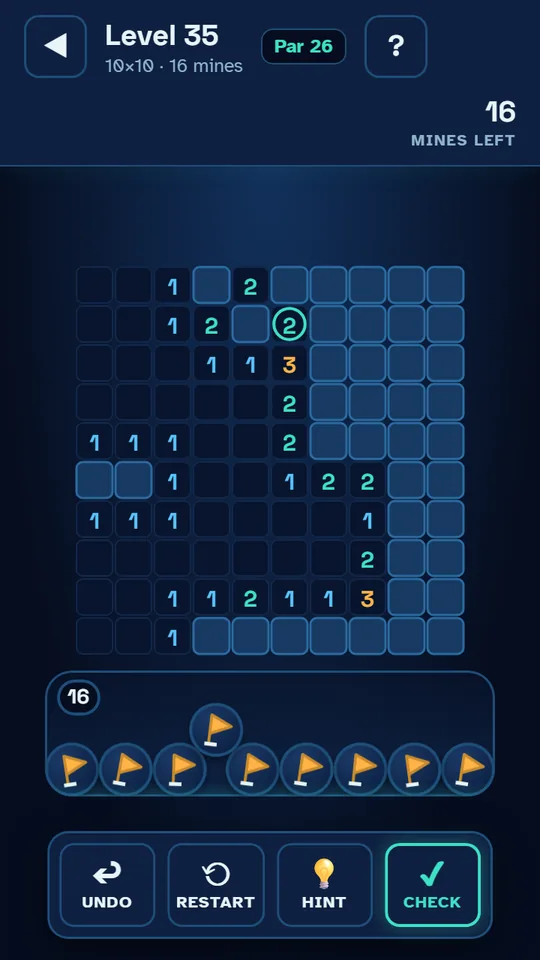
Sea mines are hidden in the reef. Numbers tell you how many mines touch each cell. Sweep every safe cell without touching a mine. Unlike classic Minesweeper, every board here can be solved by logic alone, so you never need to guess.
The goal
Sweep every cell that is not a mine. You win when only mines are left.
The rules
- Numbers count touching mines. A 3 means three of the (up to) eight cells around it are mines.
- The opening is free. The first cells are already swept for you, so you always start with something to reason from.
- No guessing. Every reef is checked by a solver that only uses logic, so there is always a certain next move.
- Rocks (from level 61) are grey. They are neither mines nor safe, and are never counted.
- Sonar cells (from level 91) have a ring. Their number counts mines within two cells instead of one.
- Edge numbers (from level 121) give the number of mines in a whole row or column.
How to play it
- Tap a cell to sweep it.
- To mark a mine, drag a flag from the bucket under the board onto the cell. The badge shows how many flags are left.
- Drag a placed flag to a new cell, or drag it off the board to put it back. In No Flags challenges there is no bucket at all.
- Hint names the technique, then shows the move. Undo and Restart are free.
Worked examples
Example 1: only one place left
Example 2: the classic 1-2-1
Example 3: use the counter
The mine counter at the top shows how many mines are left. When you have flagged all of them, every cell that is still hidden is safe. When the number of hidden cells equals the number of mines left, every one of them is a mine. This often finishes a stubborn corner.
Techniques you will learn
Hints name the technique to look for before they point at a cell, so playing the game teaches these in order.
- From the start
Simple counts
A number whose hidden neighbours are all mines, or whose mines are all found. Then the rest of its neighbours are safe.
- Level 11
Subsets
Compare two neighbouring numbers. If one’s hidden cells fit inside the other’s, the difference gives the answer (the 1-2-1).
- Level 31
Overlap
When two numbers share hidden cells, their totals can show which side holds the mines.
- Level 61
Mine count and rocks
Use the mine counter. Grey rocks are neither mines nor safe, so skip them.
- Level 91
Sonar
A ring counts mines two cells out instead of one. Work out which cells it covers before you use it.
- Level 121
Line totals
Row and column totals at the edges say how many mines each line holds. Combine them with the numbers inside.
- Level 121
Chains
Follow a long chain of numbers: try every layout along the chain and look for the cell that never changes.
How the levels grow
Reefs start at 8×8 with 10 mines and grow to 16×16 with 56 mines. Rocks arrive in the third zone, sonar in the fourth, and row and column totals in the last. The last 30 levels are Expert dives. Every level shows a par, and you collect Bronze, Silver and Gold seals in your Dive Log.
Three challenges
Clear Water
Sweep the reef before the tide comes in.
No Flags
Clear it with no flags at all. Think it through.
Deep Reef
The biggest reef, and the mine count is hidden.
Helping without spoiling it
- Ask: “Which number has only one hidden neighbour left?” and “Which two numbers sit next to each other?”
- If your child is tempted to guess, remind them that every board has a certain next move. Using Hint once shows which technique to look for.
- Because the boards are guess-free, this is a good way to learn Minesweeper thinking without the frustration of a 50-50.
There is always a hint, and in the normal game a mistake never ends a level, so it is fine to let them struggle for a while first.